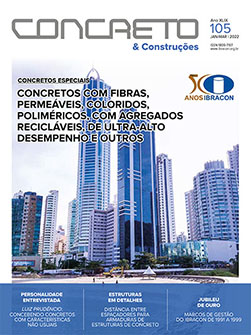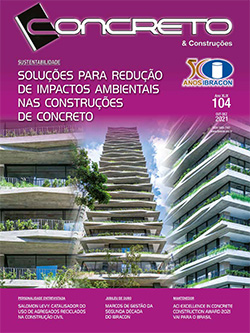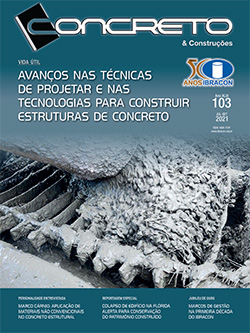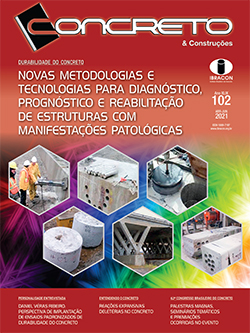
Um Analysis of the mechanical properties between High-strength and Self-compacting concretes, using an aditive and an admixture, for diferente reductions in water content
Palavras-chave:
self-compacting concrete, high-strength concrete, High-range water reducer, active additionResumo
Concrete is characterized by its workability, consistency, low cost, and rapid drying time. Once hardened, it is characterized by its high strength, absorption capacity, and resistance to water, abrasion, and other factors. For different stresses, impacts, environments, and construction technologies, to choose placement methods for different elements and structures, special concretes have been developed. It possesses specific properties suited to particular applications and the lifespan of the structures. As a result, additives have also evolved, and for the purpose of better and easier placement and high durability makes self-compacting concrete (SCC) a special type among specialty concretes. It is well known that its main property is fluidity. To achieve considerable strength, high-range water reducers (HRWR) are used, also used to achieve high strength for high-strength concretes (HSC). These reducers allow us to adjust the amount of water reduced to achieve different concrete consistencies and determine its compressive strength.
Downloads
Referências
.ACI-REPORTE DEL COMITE ACI 211 “Guide for Selecting Proportions for High Strength Concrete with Portland Cement and Fly Ash”. ACI Materials Journal, V.90, Nº 3, 1993.
.Acosta Cazal, A., Cabrera Jara, R., Rojas Holden, R. & Medina, A. ESTUDIO EXPERIMENTAL PARA EL DISEÑO DE MEZCLAS DE HORMIGONES AUTO-COMPACTANTES PARA PAVIMENTOS RÍGIDOS. Laboratorio de Materiales de Construcción/FIUNA– Campus Universitario – San Lorenzo / Paraguay.2008.
AMERICAN CONCRETE INSTITUTE, Committee 363 “High – Strength Concrete”, USA, 1993.
.AMERICAN CONCRETE INSTITUTE, Committee 211 “Standard Practice for Selecting Pro-portions for Normal, Heavyweight, and Mass Concrete”, USA, 1993.
.ANDECE, ANFAH, ANEFHOP, IECA, BIBM, CEMBUREAU, EFCA, EFARC & ERMCO. Directrices Europeas para el HAC. Especificaciones, Producción y Uso. Grupo de Proyecto Europeo (GPE) del HAC. 2005. Traducido al Español en el 2006.
.BERMEJO NUÑEZ, E. DOSIFICACIÓN, PROPIEDADES Y DURABILIDAD EN HORMIGÓN AUTOCOMPACTANTE PARA EDIFICACIÓN. DEPARTAMENTO DE INGENIERÍA CIVIL: CONSTRUCCIÓN. ESCUELA TÉCNICA SUPERIOR DE INGENIEROS DE CAMINOS, CANALES Y PUERTOS. Universidad Politécnica de Madrid. 2009. Madrid.
.Bieber, O.; Bieber, E., Flores, F.; Acosta, A.; Jiménez, J. and Rojas, R., “Manual de Materiales de Obras Civiles, tomo I volumen II – Hormigón, Armadura y Encofrado”, 2ª. Edición, Imprenta Yolysuitter, Asunción, 2019.
.Daczko, J. (2012). Self-Consolidating Concrete Applying What We Know. New York: Spon Press.
.EFNARC. (2002). Especificaciones y Directrices para el Hormigón Autocompactable - HAC.
.F.W. Locher, W. Richartz, S. Sprung, Erstarren von Zement, Zement Kalk Gips. 29 (1976) 435–442.
.Heirman, G & Vanderwalle, L. THE INFLUENCE OF FILLERS ON THE PROPERTIES OF SELF-COMPACTING CONCRETE IN FRESH AND HARDENED STATE. Department of Civil Engineering, Catholic University Leuven, Bélgica. (s/a).
.INTN, Instituto Nacional de Tecnología, Normalización y Metrología. “NP 17 044 80”, Norma Paraguaya de Cemento, Asunción, Paraguay, 8va Edición, 2025.
,INTN, Instituto Nacional de Tecnología, Normalización y Metrología. “NP 17 058 08”, Normas Paraguayas de Hormigón elaborado respectivamente, Asunción, Paraguay, 2008.
INTN-Normas Paraguayas NP 17 003 71, 17 004 71, NP 53/71, NP 66/71. Asunción.
.IRAM-Normas Argentinas 1548/71 y 1568/71. Buenos Aires. NBR 7217/87. Composición Granulométrica. Norma Brasilera. Brasil.
.Kosmatka, Steven H.; Kerkhoff, Beatrix, Panarese, William C. y Tanesi, Jussara. Diseño y Control de Mezclas de Concreto. BOLETÍN DE INGENIERÍA EB201. PCA. Skokie, Illinois. EE.UU.
.Mehta & Monteiro, 2008. Concreto. Propiedades e Infrestructura. IBRACON, Sao Paulo,
.Okamura, H., & Ouchi, M. (2003). Self-Compacting Concrete. Journal of Advanced Concrete Technology Vol. 1, 5-15.
.Olafur Haraldsson Wallevik, Jon Elvar Wallevika Rheology as a tool in concrete science: The use of rheographs and workability boxes. ICI Rheocenter, Reykjavik University, Innovation Center Iceland, Reykjavik, Iceland. 2010-2011.
http://ees.elsevier.com/CEMCON/default.asp
.ORTEGA-Hormigones Sustentables, CURSO AUGM, 2019, FIUNA, San Lorenzo, Paraguay.
.Pelaez Carretero, A. Hormigón autocompactante con nano-adiciones de sílica y alúmina. Escuela técnica Superior de Ingenieros de Caminos, Canales y Puertos. Universidad Politécnica de Madrid. 2014. Madrid.
.Puentes, García-J.Calvo & Alonso, M. “Diseño de mezclas de hormigones autocompactantes con alto contenido de adiciones minerales y áridos de diferente naturaleza para desempeño en ambientes altamente agresivos”, HAC 2018. V Congreso Iberoamericano de Hormigón Autocompactante y Hormigones Especiales. Instituto de Ciencias de la Construcción Eduardo Torroja. Madrid, Spain, 2018.
.Portland Cement Association. Steven H. Kosmatka, Beatrix Kerkhoff, William C. Panarese, y Jussara Tanesi. Diseño y control de mezclas de concreto. BOLETÍN DE INGENIERÍA EB201. 1a Edición. 2004. Skokie, Illinois, USA.
.P.D. Tennis, H.M. Jennings, A model for two types of calcium silicate hydrate in the microstructure of Portland cement pastes, Cem. Concr. Res. 30 (2000) 855– 863.
.H.F.W. Taylor, Cement Chemistry, 2nd ed., Thomas Telford, London, 1997.
.Rocha Pitta, M.; Dutra, M. and Firme Rodriguez, P. “Materiais para pavimentos de hormigón simples. Estudo Técnico 47”, Associacao Brasileira de Cimento Portland. São Paulo, 1989.
.ROJAS, R.A. “Los Hormigones Especiales-Sabiendo cómo innovar en Concreto”. Imprenta Yolysuitter. Asunción. 2024.
.ROJAS, R.A. “Adiciones, Aditivos y Fibras-Sabiendo qué innovar en Concreto”. Imprenta Yolysuitter. Asunción. 2024.
.ROJAS, R.A. Simplifying the Design of a Self-Compacting Concrete. Revista ABE, Advances in Building Education- Innovación Educativa en Edificación. DOI:https://doi.org/10.20868/abe.2025.1.5454. 2025
.Romero Esquinas, Álvaro. ESTUDIO DE HORMIGONES AUTOCOMPACTANTES FABRICADOS CON RESIDUOS INDUSTRIALES COMO FILLER. Escuela Politécnica Superior de Belmez. Universidad de Córdoba. 2018. España.
.S. Mindess, J. F. Young, D. Darwin, Concrete, Prentice Hall, Pearson Education, Inc.,
Upper Saddle River, NJ 07458, U.S.A., 2003.
.Sánchez Pérez, J.L., González García, Ma de las Nieves, Prieto Barrio; Ma. Isabel &
García López de la Osa, Gregorio. Estudio reológico experimental de un Hormigón auto-
compactante reforzado con fibras de acero. Departamento Construcciones Arquitectó-
nicas y su Control, Departamento Tecnología de la Edificación, Escuela Técnica
Superior de Edificación, Universidad Politécnica de Madrid.
Anales de Edificación, Vol. 5, Nº 2, 80-86 (2019). ISSN: 2444-1309.
.SIKA. Manual del Hormigón. Madrid (s/a).
.Sika Solutions for Sustainable Concrete. (s/a)
.Tutikian, B., & Dal Molin, D. (2015). Concreto autoadensável. 2ª ed. São Paulo: Editora PINI.
.UNE-Normas Españolas 83-109/85, 83-133/90, 83-134/90, 83-304/84.
.Zerbino,R.; Palazzi, S.; Anaya, H. & Isas, D. “Caracterización del hormigón autocompactante en estado fresco”, Jornadas Argentinas de Ingeniería Estructural jornadasaie.org.ar
.Zerbino, R.; Barragán, B.; Agulló, L.; García, T. & Gettu, R. “Reología de Hormigones autocompactantes”, Ciencia y Tecnología del Hormigón Nº 13, pp. 53-64. 2006.
. Vatsal Patel & Niraj Shah. A Survey of High Performance Concrete Developments in Civil Engineering Field. 1G. H. Patel College of Engineering &Technology, Gujarat Technological University, Ahmedabad, India. 2C. S. Patel Institute of Engineering & Technology, Charotar University of Science and Technology, Changa, India. Email: vatsalnpatel@yahoo.com, nirajshah.cv@ecchanga.ac.in
. Madhuwanthi Rupasinghe, Priyan Mendis, Ranjith Gammampila & Tuan Ngo. Nanoengineering Concrete for Sustainable Built Environment: A Review. (r.rupasinghe@student.unimelb.edu.au), (pamendis@unimelb.edu.au), (ranjith.gammampila@attra.com.au), (dtngo@unimelb.edu.au). Department of Infrastructure Engineering, University of Melbourne
. Farhad Azarmi. 2016. Emissions, physicochemical characteristics and exposure to coarse, fine and ultrafine particles from building activities. Department of Civil and Environmental Engineering. Faculty of Engineering and Physical Sciences. University of Surrey. Guildford, Surrey, UK.
Publicado
Edição
Seção
Licença
AUTORIZAÇÃO PARA PUBLICAÇÃO DE ARTIGO ou MATÉRIA JORNALÍSTICA |
|
|
|
|
|
LICENÇA PARA UTILIZAÇÃO DE OBRA INTELECTUAL (Autor)
Clausula 1 – Por este instrumento particular, o LICENCIANTE abaixo assinado autoriza ao IBRACON a utilização de obra de sua autoria, bem como dos elementos constantes nela, sem caráter de exclusividade, em publicação impressa, com prazo de vigência ilimitado, a contar da data de sua assinatura.
Clausula 2 – Esta licença é concedida a título gratuito, onde o LICENCIANTE autoriza também a LICENCIADA a incluir na publicação publicidade de terceiros que sejam compatíveis com o assunto da obra ora licenciada.
Clausula 3 – O LICENCIANTE garante não ter cedido a terceiros os direitos patrimoniais da obra ora licenciada, bem como dos elementos constantes nela.
Clausula 4 – Em caso de coautoria, o LICENCIANTE assina como um dos autores e concorda em informar aos demais da licença concedida.
|
|
|
Licenciante (nome completo em letra de forma):
|
|
|
Identificação(s) do(s) Artigo(s) ou da(s) Matéria(s) Jornalística(s):
|
|
|
CoAutores [nome(s) completo(s) em letra de fôrma]:
|
|
|
Endereço:
|
|
|
Sócio IBRACON nº |
Categoria: azul ouro diamante |
|
|
|
|
|
|
---------------------------------------------------------------------------------------
Licenciante
, de de 2021
|
Solicitamos a gentileza de preencher este formulário de LICENÇA PARA UTILIZAÇÃO DE OBRA INTELECTUAL. Por favor, encaminhar uma cópia assinada para o tel/fax 55 11 3733-2190, ou via e-mail (imprescindível assinatura, use scanner) para fabio@ibracon.org.br |